Growing the Business Beyond the Pop-Up Booth
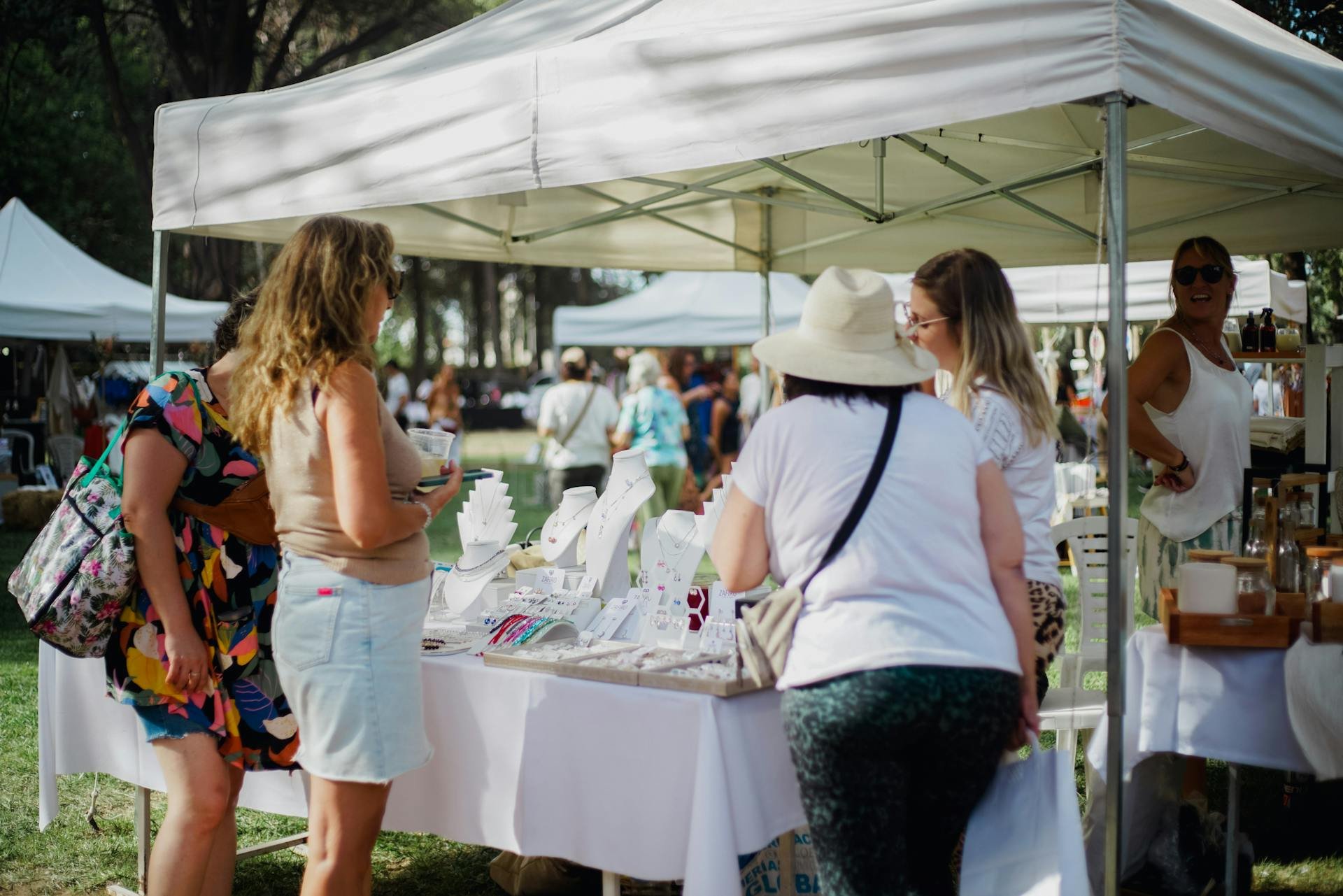
Photo by Elias Jara on Pexels.
The pop-up booth is a great foundation to start a successful business, but that is just the start.
If you’ve grown beyond your kitchen table and successfully sold your products at a weekend fair, congratulations. That is a significant milestone. Many people struggle to reach it. If you are covering the booth-fee, travel costs, and booth equipment/accessories expenses, then you are breaking even. Better yet, if after expenses, you are also generating a profit, that’s an even bigger milestone.
For many people, especially artists and craftspeople who make things by hand, generating real income is difficult because generating enough product is difficult. As someone who has personal experience in the art business, I know this is a huge hurdle, but let’s assume that things are going well and your startup is really generating a decent income.
Great news. You are now officially in business.
The Problem of Settling In
Let’s face it, when your are earning a decent income, you can get comfortable doing just that. You might even be happy with that and not want to grow further. That’s perfectly fine, and for many people that was the goal. If so, congrats, you’ve reached your goals.
But what about those who want to grow beyond the pop-up booth? This is the real challenge. That booth that you’re putting up at local vendor fairs becomes a habit. After a few successful fairs, you start to figure out what works. You may even have regular customers who come just to buy your products. This is all great news, and you’re making good money, but it’s inevitable that you start to settle and this can also lead to problems.
Let’s take a closer look at this stage of building a business, because this is often the point that many businesses stall, when it can also be a jumping off point to much greater growth. So, let’s look at this stage...
Every week you rush to generate more inventory for the next weekend. Every Thursday/Friday night you stay up late to pack the truck. The next morning you get up well before the crack of dawn to brave commuter traffic to get to the fair before the inevitable rush of all the other vendors. Then you rush to set up the booth on that cold morning... and you know there will always be early looky-loos who manage to get there before you finish. Then it’s a full weekend of smiling, making customers happy, and hopefully selling as much inventory as possible.
When the show is almost finished, you already start packing up. Then it never fails that one last chatty customer decides to waste your time. Did they even buy something? You grit and smile anyway because the customer is always right, remember? You finally get to finish cleaning up and packing your truck. Then you sit in that long line with all the other vendors trying to squeeze their own oversized trucks out of the venue and your mind wonders how the fire marshal would soooo shut this place down if they saw this spectacle...
You finally make it onto the freeway, and you rush, hungry, bleary eyed, back home. You finally arrive late Sunday night... or early Monday morning. You are too exhausted to unpack and crash on the couch, dreaming of what you’ll need to do in the late morning to repeat the whole process again for next weekend’s show...
Hey, it’s all worth it because you’re making good money, right? Well, at least you think so, because you haven’t counted it yet. You’ll need to put that into your spreadsheet against what your expenses were, and all that accounting stuff. Well, that’s another whole job, and you’ll get to that later in the week...
Yes, I’ve done that. It’s exhausting. It’s demoralizing. It’s also not where you want to be, but like millions of other artists and craftspeople all over the country, this is the life. You’re in business, but how long can you keep it up? Is this all there is to it? This is where I tell you something you are not going to want to hear:
Yes, because this is the life.
Changing your Perspective about the Pop-Up Booth Treadmill
Humans are not hamsters, and they certainly aren’t lemmings. The “life” is not sustainable unless you change the way you think about it. That was the first lesson I learned from my father who was a successful artist. He in turn learned it from other artists seemingly stuck on the same treadmill.
What my father did was change his mind set about the road lifestyle. Instead of seeing it as a depressing and never-ending treadmill, he saw it as an amazing opportunity. Two things that my father had always enjoyed, even before he became an artist working 9-5 for a large corporation, was travelling.
So, traveling for his art became a wonderful opportunity to travel across the country. With every trip he made time to see the sights. Art show in Tallahassee? That’s a great opportunity to finally drive route 66 through the Southwest, visit the incredible museums of Oklahoma City, turn south to see the French Quarter in New Orleans, and drive along the gulf to Tallahassee.
One thing that my father discovered early on is that art shows are very different across the country. As a photographer, he noticed that his art appealed differently to people further away. For example, his first few shows close to home in Southern California were busts, but when he traveled to Northern California, he saw a noticeable interest in his type of art.
Speaking with fellow artists at the shows, he quickly learned that different types of art have regions around the country that are better than others. He would never have discovered this if he had not made the conscious decision to travel in the first place, and that required a change of mindset.
Another change in mindset he made was to think of the shows as a great way to meet other artists. My father was always good with other people, especially one-on-one. As he attended art shows, he made a conscious effort to meet other artists and learn from them, especially those who had been doing this for a while and who seemed to be doing well.
So, the shows became a great social event for him. He made many friends, who then spread the word about not just his art, but also the fact that he was kind, interested, and easy to talk to – that's not always the case with artists, and some are just not very approachable.
Here is another great side-benefit of getting to know the other artists: artists buy from each other. They understand that not every show is a success, so they support each other. Sometimes they trade art instead of buying it, of course, but that is still a desired outcome.
This is because, over time, my father’s house, just like the houses of the many other artists he met, became a showcase of art from all over the country. When people came to the house, such as when customers came to buy directly, they saw this, and it provided exposure to their art too.
When he took photos for his website and social media, the other art would often also be in the background. It created an advertising vehicle for art that simply cannot be compared with expensive advertising or complex SEO tricks. Naturally, his art appeared in the photos of fellow artists too.
As a result, changing his mind set about traveling around the country and actively being present at art shows had a profound impact on his art business. Since the selection committees for shows were often made up of artists, this goodwill also had a profound impact on being selected for the best shows around the country. This also had a significant impact on the success of his shows because it allowed him to select better locations at the shows (very important) and even helped him win best-of-show and advertising spots (also great for exposure).
The Customer is Always Right
This phrase often irritates small business owners, and especially artists, but it was a cornerstone of my father’s business model. As stated above, he was always kind and understanding with other artists, but that also extended to anyone who came to his booth. My father was widely known as one of the most accommodating artists at the shows.
If a customer wanted a different frame, he immediately changed the frame on the art. As a matter of fact, he sold the frames at cost – he wasn’t in the business of selling frames. If they wanted to receive a discount for multiple pieces, my father was always willing to go well below what other artists might – hey. It's less to pack back up at the end of the show.
My father also accepted any form of payment. From checks to every credit card, cash, and trades. If someone mentioned that they were a student, a veteran, or just couldn’t afford something, he would offer steep discounts and was even known to give small pieces away for free – he always had a weak spot for young people who were genuinely interested in art.
Again, it wasn’t about trying to squeeze every possible dollar out of his customers. What my father understood very quickly was that it wasn’t about that first sale; it was about the return sale. He knew that he would be back the following year. By then, that positive experience by a customer would have been shared with others. The piece would have been hanging in someone’s home, like one with a deep appreciation for art where friends and family might share in that appreciation.
Over time, a significant number of my father’s biggest shows were the result of interest from previous shows. People would sometimes drive for hours to a show in a neighboring state just to buy my father’s art. People who received a great deal before would often come back and pay full price the next time... and often buy more pieces.
Scarcity can be a Good Thing
While my father was always kind and accommodating, he didn’t always have the piece that someone really wanted. This is a problem for all artists. Despite that, he seldom did commissioned work. This is a two-edged sword of course, because commissioned work is often more profitable. However, it also risks creating more work and it’s always for just a single customer. My father preferred to cater to more customers than the one demanding one.
This also had the effect of creating a form of scarcity for the pieces that he did have. Each piece was truly unique, by the hand of the artist. It was uniquely embossed with his signature and included a unique number for that specific piece. For his art, photography, this was particularly important. This original art wasn’t something you could pick up as Kitch wall art at Home Depot.
My father also refused to sell his art online for a very long time. He didn’t want it displayed on his website where people could simply download it, copy it, and worse, resell it – this was a growing problem for many artists, and especially photographers.
While my father did have a website, the main point was to describe the art, introduce the artist, and advertise the show schedule. He did not sell his pieces online at all.
It was not until he had become very well known that he began selling digital rights to his photos. However, this was only with vendors who specialized in respectable art production specializing in fine art. Those services only sold prints, not originals. Selling on Amazon wasn’t of any interest because my father was about quality over quantity.
Since he was still doing shows at the time, he didn’t want online print sales to impact his in-person sales. While he knew that traveling all over the country and doing shows 9 months out of the year would not be sustainable indefinitely, he wasn’t quite ready to stop either. He was still enjoying it too much.
So, it was only after more than 10 years of traveling to shows that he slowly began to explore online sales and digital rights. One of the mistakes many artists make is that they try to do this too soon. For my father it was important to establish himself first, and this he did with the art shows. Only after he had created significant demand did he slowly shift to online and digital sales.
Over time, it was the positive experiences, as well as the inevitable scarcity created with his in-person selling, that drove online sales. This may seem ironic, but that is how it happened. When he finally added online/digital sales, there was significant demand for it. For their part, all the customers all over the country who had met him in person now had something unique that wasn’t available anymore. This helped maintain the value of the original pieces and, ironically, boosted the value of prints too.
Even though the online prints were essentially copies, their value was largely dependent on the already established price of the originals. This two-tier valuing helped maintain value over time for both originals and prints, so much so that my father’s prints are still some of the top selling items from his authorized vendors.
My father also produced two books of his art. These books he produced himself and marketed with large book printers. To be honest, those were never profitable options. Ironically, this experience reinforced his belief that the core of the business was in the shows that he personally attended. Online sales of his art, whether through prints, digital rights, or even books never resulted in something he could build a business on. In truth, he saw the books more as an advertising vehicle than a source of income.
It All Comes Back to the Pop-Up Booth
The important detail that baffles so many other artists is that the entire business model was founded on the pop-up booth sales he started with originally and that he maintained for many years, even after starting to sell online. It wasn’t just how he started, but it was the only way that customers could buy originals. It was what he loved most because he shifted his mindset about the hard work involved, and so it was easy for him to justify protecting it.
After he stopped doing the pop-up shows, there were only 5 ways to acquire my father’s art:
Originals:
Once he stopped doing shows, you needed to contact him directly, visit his home, and then purchase one of the few remaining originals he still had in inventory.
Signed Prints:
My father hand-signed and numbered a select number of prints for sale online. This offers an opportunity to own unique prints that aren’t just mass-produced. These are available exclusively from his website SignedArtPrints.com.
Regular Prints:
For the largest selection of his available art, available in multiple formats, framed or unframed, prints are the way to go. They are available from two authorized online services: AllPosters.com and Art.com.
Digital Rights:
For those wishing to use the art for derivative works, in print, and in video/movies, my father’s digital rights are managed by ADLines.com. ADLines also licenses the art to large department chains like Home Depot and Walmart where it appears in many different products.
Books:
These are hard to find now, but it is the best way to see a larger selection of his many images. The book can be purchased on Amazon, although the price is rather high. You can also purchase a hand-signed autographed copy from SignedArtPrints for significantly less.
It should also be mentioned that previously-owned art occasionally appears on sites like eBay. I’ve been monitoring second-hand sales for years. While these are often sold auction-style at lower prices, they are almost always prints and not the originals. The way to tell them apart is that originals have an embossed signature on the lower right/left corner. Print copies usually cannot replicate this, so they use a printed (flat) version of the signature.
While there are many steps to build an art business beyond the pop-up booth, ultimately, it’s that venerable booth that forms the foundation of this business model. While there are certainly portions that can be outsourced – from booth setup to managing a social media presence – that booth represents the modern equivalent of the brick-and-mortar store of yesteryear. It’s a whole lot less expensive, of course, but it remains the best foundation of a growing art business.
At least, that was my father’s experience.